What I Put on My Wife's Bedside Table the Day She Came Home From the Hospital
I wrote about what happened to Ellen. This page is for the three questions I keep being asked: what exactly did the surgeon tell us to do, is it safe alongside the medication, and where do we get it.
If you are here, you probably just finished reading what happened to my wife.
Some of you read every word. Some of you skimmed to the end and clicked because one line on that list of symptoms was yours.
Either way, I will keep this page shorter than the letter. You did not come here for another story. You came here because you are on a GLP-1 medication, something in your gut has been quietly changing, and you want to know exactly what we were told and exactly what we did.
That is all this page is.
I am not a doctor, and nothing here replaces yours. Ellen made every medical decision with two of them. What I can give you is the protocol we followed, word for word, and where to find the bottle that was waiting on her bedside table the day she came home.
What the surgeon told us was happening
For anyone who skimmed, here is the explanation Dr. Adeyemi gave me in his office on day four, compressed as far as I can compress it.
Your colon is a muscle. To move waste, it has to contract. To contract, it needs a signal — a short-chain fatty acid called butyrate, made by bacteria that live in your colon and ferment the fiber you eat.
GLP-1 medications slow your entire digestive transit. That is part of how they work, and it is part of why they work. But that slow transit changes what actually reaches those bacteria. The food they ferment stops getting down to them.
By month two or month three — his words — those bacterial populations are already at a fraction of what they were in many users. When the bacteria crash, the butyrate crashes with them. The colon stops getting the instruction to move. Waste builds. Pressure builds.
In my wife's case, at week ten, the pressure found a weak spot in the wall of her colon on a Saturday night, halfway through a plate of roast chicken.
Nothing about this announces itself. That is the part I need you to hear. For ten weeks, the only warning we got was a slowdown we wrote off as a side effect she would adjust to.
Why nothing in the cabinet was fixing it
Once you understand the mechanism, you understand why the usual answers were not working — and were never going to.
Miralax pulls water into the colon so that today is easier. It does nothing for the bacteria. Tomorrow there are fewer of them than there were today. It is, as I wrote in the letter, a band-aid on the wrong wound.
Bulk fiber — the coarse, thick kind in most fiber products — packs more mass into a colon that has lost its signal to move. That is not help. That is load. It is part of what made Ellen worse.
Probiotics send new bacteria down into a colon where the food supply has collapsed. They starve the same way the original ones did.
And quitting the medication — which is where some women land, out of fear — was never on the table for Ellen. Her medication was doing exactly what it was supposed to do. Her A1C. Her weight. The food noise. The medication was not the failure. The starvation underneath it was the thing nobody was watching.
The two things he said mattered
When I asked Dr. Adeyemi what to do, he did not give me a brand first. He gave me two requirements.
First: apigenin. A compound concentrated in celery juice. It does two jobs at once — it helps the right bacteria grow back, and it calms the inflamed lining of the colon while they do. And because it barely absorbs into the bloodstream, it stays down in the colon, where the work actually has to happen, instead of being carried off.
Second: a low, gentle dose of soluble fiber. Not bulk fiber. A soluble fiber that dissolves and feeds the bacteria you are trying to bring back, so they survive and multiply.
Then he said the sentence that saved me two weeks of comparison shopping: most products on the market have one of those two. Some have neither — they are just a laxative, or a tub of bulk fiber.
The bottle he named
The one he named — the one he said the post-op GLP-1 patients in his hospital were actually using — is called Motilli.
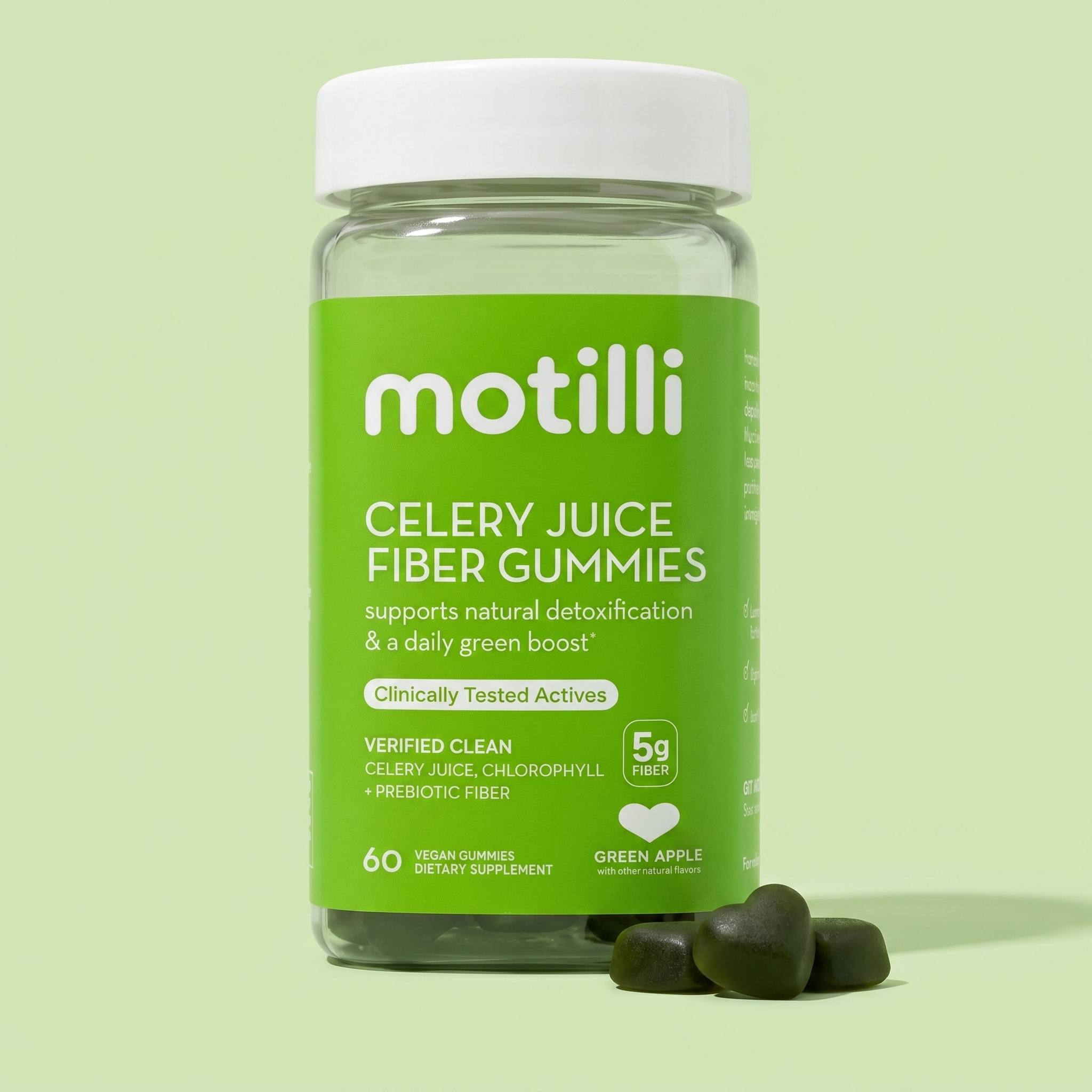
I want to be plain about what it is and what it is not.
It is a gummy. A bottle holds sixty. It contains the apigenin, from celery juice, and the low-dose soluble fiber — both requirements, in one bottle. It is not a laxative. Nothing about it forces anything. Which also means nothing dramatic happens on night one — and I will get to that.
The day Ellen came home from the hospital, the bottle was on her bedside table. She took the first three that night, and she has taken three every night since.
What to expect — and what not to
The company would probably write this section differently. But you came to this page from my letter, and I told you I would not embellish.
Expect nothing for about three weeks.
That is not a defect. The decline was silent, and the rebuild is silent too. Bacteria that starved over months do not grow back over a weekend. Dr. Adeyemi told us three weeks before we should expect to feel anything at all, and he was right almost to the day.
I can only give you Ellen's timeline, and I will be honest that hers is not a normal case — she was recovering from surgery while the rebuild happened. Around week four, she said her abdomen felt "less hard." By week eight, she was sleeping through the night, her bloodwork was clean, and the imaging of her lower colon looked better than her surgical team expected. Dr. Adeyemi's nurse told us: "Whatever you are doing, keep doing it."
Your starting point, God willing, is nothing like hers. But the rule he gave us holds either way: judge nothing before three weeks. Quiet first. Then movement.
The math on the bottles
Here is the one piece of arithmetic that matters.
A bottle is sixty gummies. Three a night is twenty days. The three-week mark — the earliest point Dr. Adeyemi told us to expect anything — arrives after your first bottle is already empty.
So a single bottle is not really a test of anything. If you are going to do this, do it the way it was prescribed to us: as a rebuild, measured in months, not as a thing you try for a week.
The company sells it one way that makes sense for that. Buy two bottles and they add a third free, with free shipping. Three bottles is sixty days — long enough to be well past wondering.
I have no countdown clock for you and no claim about how many bottles are left in a warehouse. As far as I know, it is their standing offer. The only urgency on this page is the list further down — the one from the end of my letter.
The guarantee
Ninety days, money back.
In the letter I said: if it does not do for you what it did for my wife, you send the bottle back and you have lost nothing. Since writing that, I have learned it is even simpler — they do not require you to send anything back. You email them inside ninety days and every dollar comes back.
The ninety days matters for a reason. A company selling a three-week rebuild cannot hide behind a thirty-day window. The guarantee outlasts the timeline. That is the right order.
Ask yourself the same five questions
If you are on a GLP-1 medication, this is the list from the end of my letter. Read it slowly.
- A constipation pattern that has been getting slowly worse over weeks or months.
- A vague heaviness in your lower abdomen that you are writing off as bloating.
- A slow change in how often you go that you have stopped paying close attention to.
- A sense that the Miralax is not really working anymore — but you keep buying it anyway.
- A bigger Miralax box than you used to buy.
If even one of those is you, understand what it means underneath: the bacteria are not waiting to see how your month goes. Every week the transit stays slow, there are fewer of them. The rebuild only gets longer from here.
Questions I keep being asked
From readers of the letter
Reader responses are representative of messages received and are shared for illustrative purposes. Results vary.
The bedside table
I will end where the letter ended, because nothing about it has changed.
We almost did not get her back. Seventeen days in a hospital. A stoma bag for three months. A second surgery, and a long recovery on the other side of it.
The bottle that was waiting on her bedside table cost less than what I paid the hospital parking garage over those seventeen days.
If the list above has even one line that is yours — do not wait until someone has to write a letter like mine about you.
Please.
— Paul